 Interview:
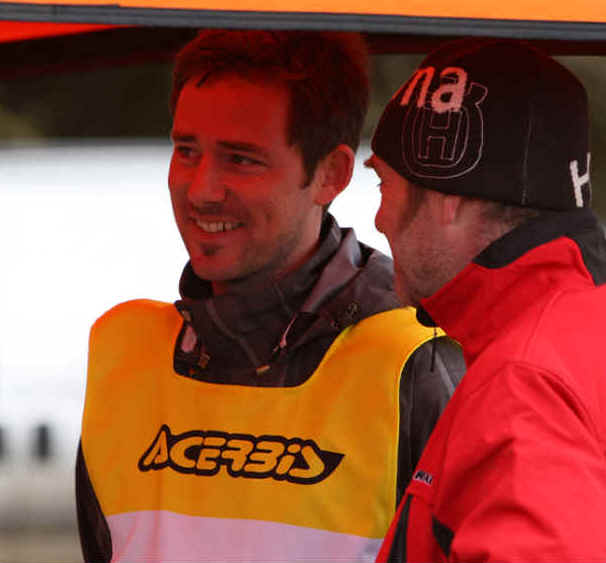
Jonty Edmunds - events director of the ACU British Enduro Sprint Championship. Interview:
Jonty Edmunds - events director of the ACU British Enduro Sprint Championship.
The new for '10 ACU British Enduro Sprint Championship (BESC) has attracted
a lot of attention in the past three months, and rightly so. Featuring a
stellar line up of the country's top enduro riders, spectators have been
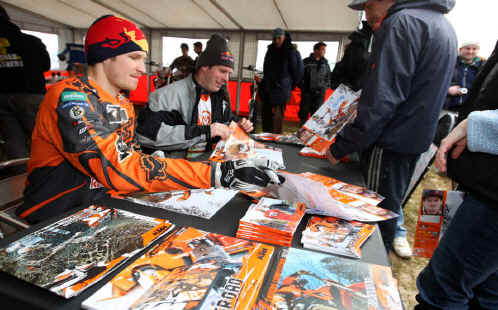
treated to top quality racing while being able to get up close with riders off
the track. With the final round of the '10 championship approaching this
weekend we figured it was time to catch up with Jonty Edmunds, events director
of series organisers GMC Events Ltd, to find out how the championship has
progressed.
Hi Jonty, thanks for taking the time to sit down to talk. Firstly why
did you decide to get involved in setting up something like the BESC?
Jonty: "I've been involved in enduro sport all my life and the BESC is an
idea that I'd been bouncing around in my head for a while to be honest. I felt
that an enduro sprint championship would be an opportunity to address some of
the issues surrounding traditional time card enduros. I wanted to simplify the
current enduro format and make it exciting not just for riders but for all
involved, primarily spectators and rider support crews. For a long time now on
the International enduro scene events have become much more special test
orientated. In Britain we have kind of fallen behind with that. I originally
looked at ways of increasing the number of tests used in traditional time card
enduro events, but even by doing that you don't necessarily rectify some of
the other issues, that's why I set-up GMC Events Ltd and started from scratch
with the BESC."
 Where
did the idea for the format come about? Where
did the idea for the format come about?
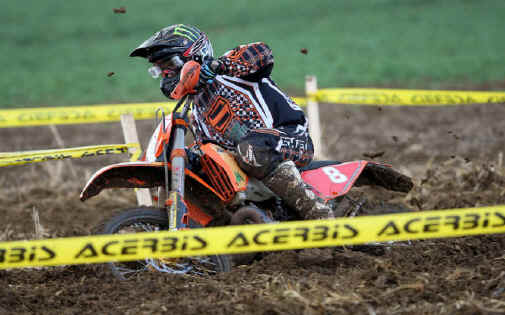
"The format is one that is common in Australia, where sprint enduro
events have been running successfully for a number of years. Enduro is one of
the longest standing off-road motorcycle disciplines but has remained
fundamentally largely unchanged, especially in the UK. If you look at events
like the Winter Olympics they've modernised and introduced new, exciting,
disciplines like Boardercross and Ski Cross, to make sure they continue to
connect with a younger audience. Hopefully, in a similar way, the BESC will
compliment traditional enduro events and championships while injecting new
life into enduro."
Given that this series has British championship status, how have the ACU
accepted it?
"The ACU has been fantastic, they understand what issues we are trying to
tackle and what it is we are trying to achieve. They've really supported the
series from the outset and have shown their support in awarding it British
championship status. They can see that as organisers and promoters of the
entire series, GMC Events can deliver quality and continuity. We feel that
each round of the championship should look, feel, and be organised, in the
same way."
 With
four rounds completed how has the championship progressed so far? With
four rounds completed how has the championship progressed so far?
"From an organisational point of view everyone involved is really happy
with the progress we've made to date. It was always going to be a learning
year for us, as an organisational team. We knew that we would have a lot to
learn but also due to it being a new concept there has also been a lot of work
involved in introducing the new concept to the competitors, spectators, media
and the general public. We've also put a lot of time and effort into getting a
BESC website, www.enduro-sprint.com
, up and running, which we're very happy with. But above all else what has
been encouraging is that a high percentage of those that competed at rounds
one and two returned again for rounds three and four. Hopefully that shows we
are doing something right."
With a new concept it is inevitable that teething problems will occur.
Are you listening and acting upon the comments competitors and public are
saying?
"Yes, definitely. Constructive criticism is always important, as we want
to improve the championship. However we know what we're trying to achieve so
certain fundamental elements can't be changed too much. We want to keep the
BESC as something that's simple to understand. Riders go to the start line of
the special test, do their special test, then return to the pits and get ready
to do it all over again about 20 minutes later. It's an interactive format on
many level."
One thing that's certain with the sprint format is that it's a busy
schedule for riders, there's no hanging around. I'm guessing the format was
well planned, keeping riders on their toes throughout each day?
"Initially people were wary that there might be lots of hanging around
throughout the day, but I think we've proved that's certainly not the case. In
a traditional enduro in the UK you ride up to six hours a day but only race
for a maximum of 30 minutes. With BESC events you race all day, every second
counts. From the moment a rider starts his first test until they cross the
finish line of the final test they are at race speed. That's what's different
about the BESC, it's racing, racing, racing."
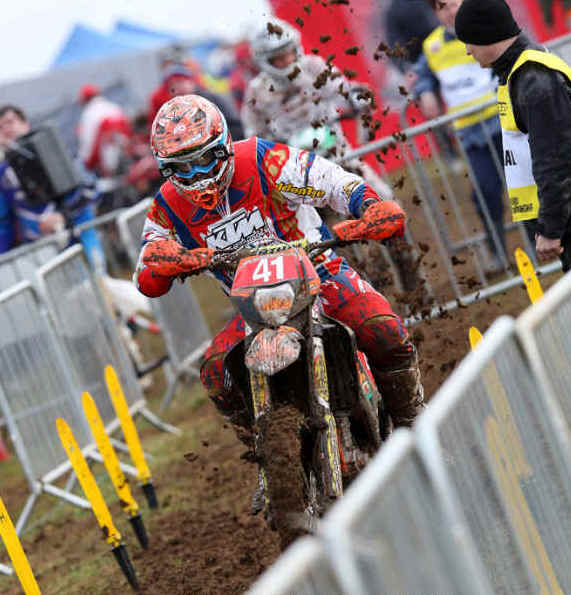 A
unique addition to the BESC is the Under 23 category. What's the reasoning
behind it? A
unique addition to the BESC is the Under 23 category. What's the reasoning
behind it?
"It was to try and bring things more in line with what is happening
internationally. There is an Under 23 class at the World and European
championships along with the International Six Days Enduro. It seemed logical
to have a national Under 23 class here because that's how some riders would
compete internationally. Hopefully by putting all those riders into the same
class it will bring them on. One thing we're considering for '11 is the
introduction of an Under 18 class, possibly for 125cc two-stroke riders."
Personally how have you found the challenge of being an organiser and
not just being involved for a media aspect?
"I'm really enjoying it. It's very new to me but I knew there would be a
lot of work involved as one of the things I'm trying to do is raise the
profile of enduro sport - trying to take care of some of the smaller details.
Those small aspects can make the difference between running a race and hosting
an event. One thing I've learnt though is that you need three things to make
any event a success - a good venue, a good team of workers, and good weather.
We can only control two of those things. Fortunately, we have an experienced
team at all events that work incredibly hard to keep things running
smoothly."
I'm sure you're focused on finishing out this championship first, but
what can we expect for 2011?
"One thing we'd like to do is extend the series, not by a huge amount but
by two or three days. We've always said that one of the objectives of the
series was to offer competition focused events early in the season, which will
help all British riders looking to compete internationally. We want to
continue doing that so the championship will again run during the first half
of the season. Basically, we simply want to build on what we have started this
year. We will release more information on next year's championship towards the
end of the year, once the international dates have been set by the FIM."
What is in store for the final round coming up this weekend?
"This venue at Saints Well, Mid Wales, will be a similar venue to the
opening rounds and will be mainly cross country based. I'm confident it'll
match the standards of Chavenage Farm and Rogershill Raceway and be a really
good end to the series. We're also planning a social event on the Sunday
evening after the race to tie in with the Bank Holiday weekend. I'm confident
it'll be a great end to the series."
The British Enduro Sprint Championship draws to a close this weekend May
29/30 at Saints Well, Rhayader, Mid Wales.
Interview: Robert Lynn
Photos courtesy of GMC Events Ltd
|